Homogeneous Asymmetric Catalysis
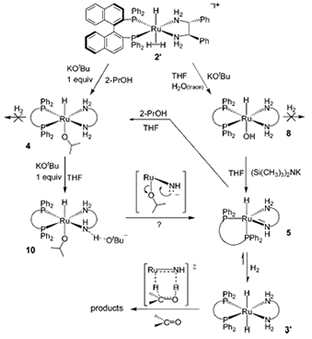
We recently developed the first low temperature high yielding syntheses of several putative intermediates in the metal ligand bifunctional mechanism. We found that the BINAP-containing cationic η2-H2 intermediate trans-[Ru((R)-BINAP)(H)(η2-H2)((R,R)-dpen)]+ (BINAP = 2,2'-bis(diphenylphosphino)-1,1'-binaphthyl, dpen = 1,2-diphenylethylenediamine) does not hydrogenate ketones in the absence of added as previously proposed. Additionally the η2-H2 is extremely labile and has quite possibly the shortest H-H bond distance (~0.802 Å based on 1JH-D = 37 Hz) of coordinated H2 ligand. We also prepared the intermediates involved in the key hydrogenation step, namely the amide [Ru((R)-BINAP)(H)((R,R)-NH(CH(Ph))2NH2))] and the dihydride trans-[Ru((R)-BINAP)(H)2((R,R)-dpen)]. We found that the amide reacts rapidly with the weak acids 2-PrOH, H2O, and H2 to form the alkoxide trans-Ru((R)-BINAP)(H)(2-PrO)((R,R)-dpen), hydroxide trans-Ru((R)-BINAP)(H)(OH)((R,R)-dpen), and the dihydride , respectively. The alkoxide and hydroxide species are remarkably stable, tolerating extended exposure to H2 gas at room temperature without further reaction or decompostion.
Our current research is investigating how these intermediates react in the mechanism of these hydrogenations and we are using this knowledge to expan the use of these catalysts in other reactions.