Homogeneous Asymmetric Catalysis
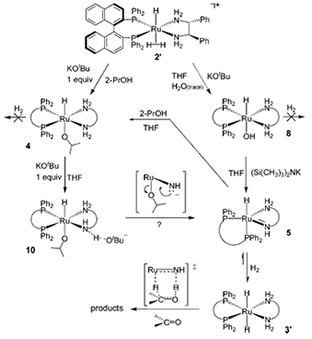
The enantioselective catalytic hydrogenation of polar bonds ( e.g. ketones, aldehydes, imines) is a fundamental reaction in the perfume, pharmaceutical, and fine chemical industry. Noyori et al 's development of the catalyst system trans- Ru(diphosphine)Cl2(diamine) plus base in 2-PrOH is amongst the most significant advancements in these hydrogenations. This system and its variants can hydrogenate a gamut of ketones with high enantiomeric excess ( ee ) and turnover numbers (TON). Noyori et al proposed that these hydrogenations proceed through a ligand assisted bifunctional addition of a nucleophillic hydrogen on ruthenium and a protic hydrogen on nitrogen to the carbon and oxygen of the ketone, respectively. Model compounds have shown that the active catalytic species is trans-Ru(diphosphine)H2(diamine). The mutually trans position of hydride ligands activate them towards ketone hydrogenation. However, comprehensive NMR studies of this "metal-ligand bifunctional mechanism" are hindered by long iniation times to convert precursors into catalytic intermediates, thermal decomposition of these intermediates, and by the key hydrogen atoms involved, the N-H, Ru-H, and Ru-η2-H2, undergoing rapid H-D exchange with 2-PrOH-d8 solvent.
| << Previous | Next >> |