Research Interests
The research interests of the Veinot Group focus on the synthesis, properties, and applications of "functional" materials. An underlying theme pervading all our research is: "How can our understanding of chemistry better our comprehension, and facilitate the application of the materials we study?" To date, we have established five project areas, currently at different stages of development, which are briefly outlined below.
Group IV semiconductor nanocrystals

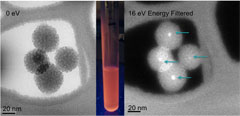
It is well established that many variables influence the properties of semiconductor nanoparticles (NPs), among these are size, shape, crystal structure, and surface chemistry. An ideal preparative method would effectively address all of these issues. Such a method should also yield tangible quantities of easily purified products from readily available, non-hazardous precursors. With this in mind, a major thrust of our program is to develop more effective methods for preparing Group IV semiconductor NPs. We have investigated numerous approaches and established hydrogen silsesquioxane (HSQ) as a versatile thermal precursor to Si nanocrystals embedded in SiO2 (nc-Si/SiO2). Freestanding Si nanocrystals (nc-Si) may be freed from the oxide matrix in tangible quantities via a variety of etching procedures (see figure). Most importantly, using a very chemical approach and state-of-the-art techniques, we have developed a detailed understanding of the processes that lead to particle formation and growth.
We also showed HSQ's solution processability allows for fabrication of nc-Si/SiO2 thin films on flat (e.g., silicon wafer) and non-flat (e.g., fiber optic cables) substrates that are readily patterned to produce well-defined sub-10 nm photoluminescent features (see figure).
Currently, no other method for preparing nc-Si or nc-Si/SiO2 offers comparable flexibility and utility.
We have divided our investigations of HSQ-derived materials into the following five interconnected sub-categories, (i) tailoring particle physical properties through core composition and shape control, (ii) establishing methods for preparing robust, as well as labile NPs surface functionalization, (iii) understanding the influence of surface chemistry and core composition on particle optical response, (iv) developing HSQ-like precursors for preparing other Group IV NPs (e.g., Ge, Sn), and (v) device application.
- Representative papers
- "An investigation of the formation and growth of oxide-embedded silicon nanocrystals in hydrogen silsesquioxane-derived nanocomposites."C.M. Hessel, E.J. Henderson, J.G.C. Veinot, Journal of Physical Chemistry C, 2007, 111, 6956-6961.
- "Synthesis of oxide encapsulated and freestanding hydride surface terminated Si1-xGex nanocrystals." E.J. Henderson, J.G.C. Veinot, Chemistry of Materials, 2007, 19, 1886-1888.
- "Hydrogen silsesquioxane: A molecular precursor for nanocrystalline Si-SiO2 composites and freestanding hydride-surface-terminated silicon nanoparticles." C.M. Hessel, E.J. Henderson, J.G.C. Veinot, Chemistry of Materials, 2006, 18, 6139-6146.
- "Synthesis, surface functionalization, and properties of freestanding silicon nanocrystals". J. G. C. Veinot, Chem. Commun., 2006, 40, 4160-4168.
- "Preparation of alkyl-surface functionalized germanium quantum dots via thermally initiated hydrogermylation." E. Fok, M. Shih, A. Meldrum, J.G.C. Veinot, Chemical Communications, 2004, 386-387.
- "Reductive thermolysis of a heterocyclic precursor: a convenient method for preparing luminescent, surfactant-stabilized silicon nanoparticles." B.D. Rowsell, J.G.C. Veinot, Nanotechnology 2005, 16, 732-736.
Fe/FeXOY Nanoparticle Applications
Iron/iron oxide nanoparticles (Fe/FeXOY) are also of interest to our Team. The primary focus of this aspect of our research program is the practical application of these systems. Recently, we showed catalytic precious metal ions (e.g., Ru2+/3+, Rh2+, Pd2+, and Pt2+) could be sequestered from aqueous and organic reaction media. Our studies indicated that these ions were reduced to their metallic state and deposited onto the Fe/FeXOY particle surface. The resulting byproduct was readily extracted by magnetic filtration.
While other groups have reported similar results for removing non-catalytic metals from groundwater, prior to our work the full sequestration capacity of Fe/FeXOY for catalytic metals was unknown. Also, the generally accepted mechanism for metal ion extraction from aqueous media relies heavily on surface wetting of hydrophilic particles; this could prove problematic for hydrophobic organic systems. As a result, it was unclear if stringent pharmaceutical regulatory requirements for metal contamination in organic materials could be realized. Furthermore, the question remained, "Would Fe/FeXOY induce adverse side reactions?"
Recently, we extended the scope of this project to the sequestration of more complex catalytic systems containing competing coordinating ligands that could prevent metal ion surface coordination and capture. Ongoing work includes, (i) establishing methods for tailoring Fe particle surface chemistry, (ii) studying the possibility of selective metal sequestration, (iii) applying this method to other practical systems such as polymers used in organic electronic devices, and (iv) investigating Fe/FeXOY induced metal deposition as a preparative method for metal-based nanomaterials.
- Representative papers
- "Iron/Iron Oxide Nanoparticle Sequestration of Catalytic Metal Impurities from Aqueous Solution and Organic Reaction Products."J. Macdonald, J. Kelly, J.G.C. Veinot, Langmuir, 2007, in press.
Organosiloxane and SiO2 Nanofiber Preparation.
We have developed a straightforward method for preparing surface bonded, organic functionalized siloxane nanofibers. As is the case with all our other projects, we have extensively characterized our films in an effort to better understand what factors influence their formation and growth. With this knowledge, we have established procedures that afford control of fiber dimensions and spatial density. Our first demonstrated application of these fibers was controlling substrate surface wettability.
We have also determined that high temperature thermal processing (i.e., >1000oC) removes all organic surface groups rendering fibers hydrophilic. The resulting robust "oxide" fibers are readily functionalized. In addition, the oxide fiber composition strongly depends on the thermal processing atmosphere. Under the correct processing conditions, fibers with compositions similar to the nc-Si/SiO2 thin films noted above are obtained. Preliminary data suggest the presence of Si nanocrystals in the fibers.
With these materials in hand, our ongoing investigations will include: (i) tailoring fiber composition and surface chemistry, and (ii) investigating their application as catalyst supports, optical components, separation and refractory materials.
- Representative papers
- "Formation and aqueous surface wettability of polysiloxane nanofibers prepared via surface initiated, vapor-phase polymerization of organotrichlorosilanes ." D.-A.E. Rollings, S. Tsoi, J.C. Sit, J.G.C. Veinot, Langmuir, 2007, 23, 5275-5278.
Polymers for Optoelectronic Applications.
The Veinot Polymer Light-Emitting Diode (PLED) Team addresses challenges facing the PLED community using rational chemical design. Two challenges that should be readily addressed by structural chemistry are the well-established thermal/oxidative instability and low e--mobility of the status quo blue emitting polymer used in commercial PLEDs, dioctylpolyfluorene (PFO).
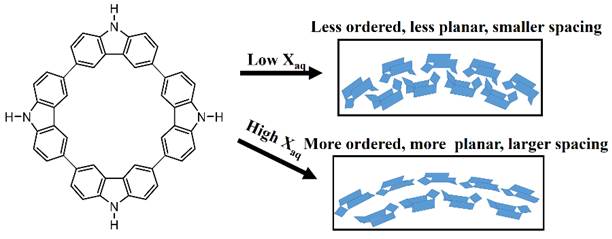
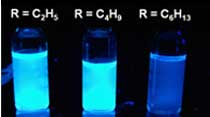
We have established methods for preparing high-purity, well-defined polymers with aromatic polyether (APE) side chains at the 9 and 9« positions of the fluorene ring system (PFA) (see figure) APEs are known industrial thermal plastics and could address PLED stability issues. Side chains may also induce polymer ordering that could improve polymer electronic characteristics without compromising device performance metrics.
Our structural approach proved successful in increasing the polymer thermal stability by ca. 150oC (PFA vs. PFO) and negligible oxidative degradation was observed upon heating PFA in air (see figure).
Recently, we established the expertise to fabricate and characterize PLEDs in our laboratory. We will be evaluating our polymers in standard PLED devices and systematically tailoring their structure to realize optimum device metrics. We will also investigate our PFA series of polymers/oligomers for their liquid crystalline behavior, ability to coordinate known luminescent metal centres, and as surface groups on our semiconductor nanoparticles.
- Representative papers
- "2,7-Dibromo-9,9-bis(4-hydroxyphenyl)-9H-fluorene" S. McFarlane, R. McDonald, J.G.C. Veinot, Acta Crystallographica Section E,
2006, 63, o748---o749.
- "2,7-Dibromo-9,9-di-n-octyl-9H-fluorene." S. McFarlane, R. McDonald, J.G.C. Veinot, Acta Crystallographica E, 2006, E62, o859-o861.
- "9,9-Di-n-octyl-9H-fluorene." S. McFarlane, R. McDonald, J.G.C. Veinot, Acta Crystallographica C, 2005, C61(12), o671-o673.
Surface Chemistry and Nanostructured Films.
The Veinot Team has also actively collaborated with the Sit and Brett Groups (U of A, Electrical and Computer Engineering) to tailor the surface chemistry, aqueous wettability, and chemical response of nanostructured SiO2, Al2O3, and TiO2 films. Our methods control film surface chemistry, do not compromise their integrity, and improve film-based device performance.
Of late, this collaboration has expanded to include the influence of substrate surface chemistry on the deposition of nanostructured organic thin films as well as the formation of precursor films for the fabrication of structures containing nc-Si.
- Representative papers
- "Vapor-phase chemical functionalization of high porosity, nanostructured thin films." S. Tsoi, E. Fok, J.G.C. Veinot, J.C. Sit, International Journal of Nanoscience, 2007, 6, 103-107.
- "Controlled Growth of Silicon Oxide Nanowires from a Patterned Reagent." F. Wang, M. Malac, R. F. Egerton, A. Meldrum, P. Li,
M. R. Freeman, J. G. C. Veinot, Journal of Physical Chemistry C, 2007, 111, 1865-1867..
- "Surface Functionalization of Porous Nanostructured Metal Oxide Thin Films." S. Tsoi, E. Fok, J.G.C. Veinot, J. C. Sit, Chemistry of Materials 2006, 18, 5260-5266.
- "Porous nanostructured optical filters rendered insensitive to humidity by vapor-phase functionalization." A.C. van Popta, J.J. Steele, S. Tsoi, J.G.C. Veinot, M.J. Brett, J.C. Sit, Advanced Functional Materials, 2006, 16, 1331-1336.
- "Superhydrophobic, High Surface Area, 3-D SiO2 Nanostructures through Siloxane-Based Surface Functionalization." S. Tsoi, E. Fok, J.C. Sit, J.G.C. Veinot, Langmuir, 2004, 20,10771-10774.